
The doctor said one word as your mother was being discharged. Rehabilitation. And now you’re standing in the hospital corridor with a discharge summary in one hand and no real idea what comes next.
Should she stay somewhere and recover under supervision? Or come home and visit for sessions? That single choice, in-patient or out-patient, shapes how the next few weeks go. Get it right and recovery has room to breathe. Get it wrong and you’re either paying for care she didn’t need or leaving her without the support she did.
Nobody explains this part well. So let’s do that here.
By the end, you’ll know which one actually fits your parent, and why the answer changes more often than people expect.
What in-patient rehabilitation gives your parent
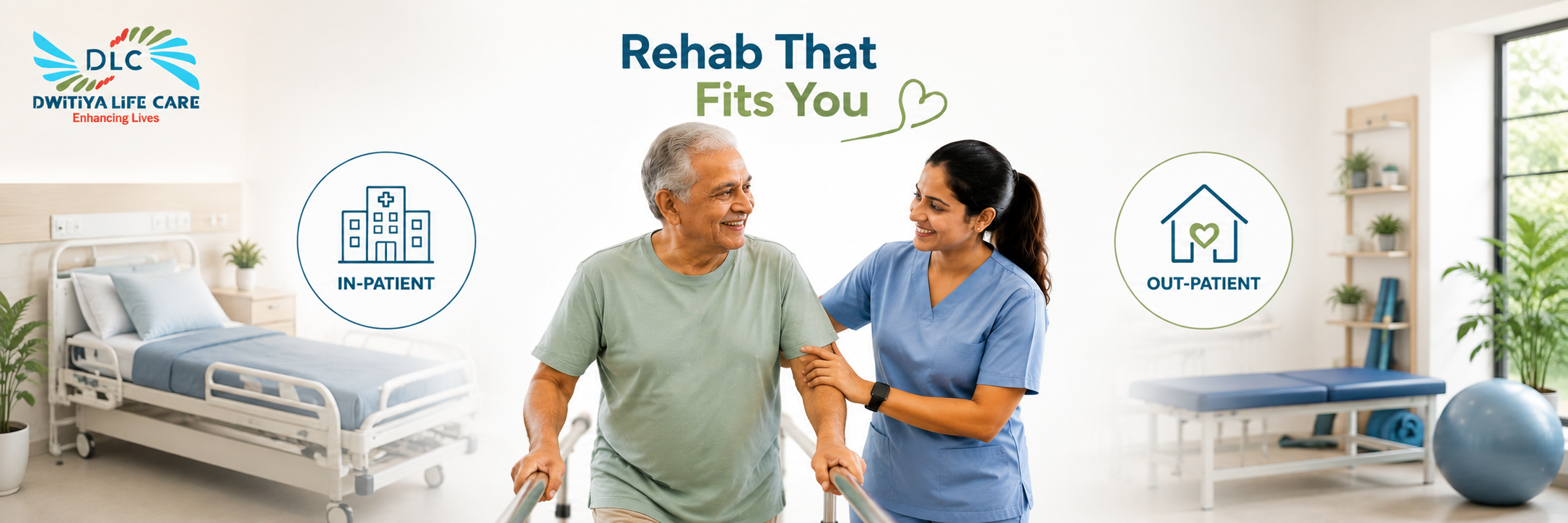
In-patient means your parent stays at the centre and recovers there, full time. Round the clock.
This is the intensive option. Your parent lives on site for days or weeks, with nurses and therapists on hand at any hour. Therapy happens daily, sometimes more than once, and everything around it, meals, medicines, rest, movement, is built to support that recovery. Nothing depends on whether someone at home remembered the exercises.
It’s the right call when recovery is serious or fragile.
After a major stroke, a big surgery, or a bad fall, the early weeks of recovery matter more than any stretch that follows. That’s exactly when constant supervision earns its place. If your mother can’t yet stand safely on her own, home is not where she should be figuring that out. A good rehabilitation programme gives her that safety while she slowly rebuilds. That’s what it’s for.
When out-patient rehabilitation is the smarter choice
Out-patient flips the arrangement. Your parent lives at home and comes in for scheduled sessions, then goes back to their own bed at night.
This suits people who are past the fragile stage. They can move around reasonably, manage most of the day, and just need regular expert sessions to keep progressing. Physiotherapy, guided exercise, a check on how things are healing. Then home again.
Home has its own quiet power in recovery.
For many older adults, being in familiar surroundings, their own chair, their own routine, their own people, does something no ward ever can. They sleep better and stay in better spirits. Out-patient also works for families who can supervise safely between visits, and it pairs naturally with our out-patient services for ongoing health reviews. Less disruption. And it’s kinder.
The differences that actually change your decision
Strip away the jargon and it comes down to a few real things. A few, not many.
Supervision is the big one. In-patient gives round-the-clock eyes on your parent. Out-patient gives a few supervised hours, then the responsibility comes home with you. Intensity is the next. Living at the centre means therapy every single day, while visiting means progress moves at the pace of the schedule and the traffic.
Then there’s cost, and let’s not pretend it doesn’t matter.
In-patient care costs more, because you’re paying for the stay, the round-the-clock team, and everything that surrounds it. Out-patient is lighter on the wallet but leans on the family to fill the gaps at home. Neither is better. One is right for a specific person at a specific point in their recovery. That’s the truth. Distance matters too, more than families expect. A daily out-patient trip across Bangalore in peak traffic can quietly exhaust a frail parent before the therapy session has even started.
How to tell which one your parent needs right now
Start with one honest question. Can your parent be safe at home between sessions?
If the answer is a clear yes, out-patient probably fits. They’re steady enough, someone’s around, and home is doing them good. If the answer is no, or even a shaky maybe, that hesitation is your answer. In-patient exists for exactly that gap.
Look at three things together. How serious the recovery is, how safe the home is, and who is actually free to help during the day. A parent recovering from a hip replacement in a first-floor flat with no lift, cared for by a working son, is a very different case from one with steady help at home. Same surgery. Completely different answer. It’s that specific. When you’re weighing a rehabilitation centre in Bangalore, factor in the daily commute too, because it quietly becomes part of the treatment. For older adults juggling several conditions at once, pairing rehab with geriatric care often makes the safer path clearer.
Why you don’t have to choose just once
Here’s what nobody tells you at discharge. This isn’t a one-time, permanent decision.
Most recoveries move in stages. Plenty of people start with in-patient while things are fragile, then step down to out-patient once they’re steadier, then taper to a weekly visit, then stop. The care follows the recovery, not the other way around. That’s the rule.
That flexibility is the whole point.
A good centre tells you honestly when it’s time to move your parent from one to the other, even when that means less business for them. If yours doesn’t, that tells you something. At our Girinagar and Jayanagar centres, we plan for that shift from day one, so nobody stays admitted a day longer than they need to. Recovery should keep moving. So should the plan around it.
Frequently Asked Questions
What is the main difference between in-patient and out-patient?
In-patient means your parent stays at the centre full time with round-the-clock care, while out-patient means they live at home and come in for scheduled sessions. In-patient suits serious or early recovery that needs constant supervision. Out-patient suits people who are steadier and safe at home between visits. The right one depends on where they are in recovery.
Is out-patient cheaper than in-patient?
Usually yes, because you’re not paying for the stay and the round-the-clock team. But cost isn’t the only maths. Out-patient leans on the family to supervise and support at home, and daily travel across the city takes its own toll on a frail parent. Weigh the full picture, not just the fee, before you decide.
How long does rehabilitation usually take?
It depends entirely on the person and the reason for it, so there’s no fixed number. Recovery after a minor procedure can take a few weeks, while a major stroke may need months of steady work. What matters more than the total time is consistency. Progress comes from showing up, session after session, without long gaps.
Can my parent switch from in-patient to out-patient?
Yes, and many do. It’s actually the most common path. People often start in-patient while recovery is fragile, then step down to out-patient once they can manage more at home. A good rehabilitation centre plans for that shift and moves your parent along as soon as they’re ready, rather than keeping them admitted longer than needed.
Working out the right kind of recovery for someone you love is hard, and you don’t have to guess at it alone. Talk to us about our rehabilitation programme at Girinagar and Jayanagar, and we’ll help you weigh in-patient against out-patient honestly, for your parent’s actual situation. Whatever fits them best is what we’ll point you towards.